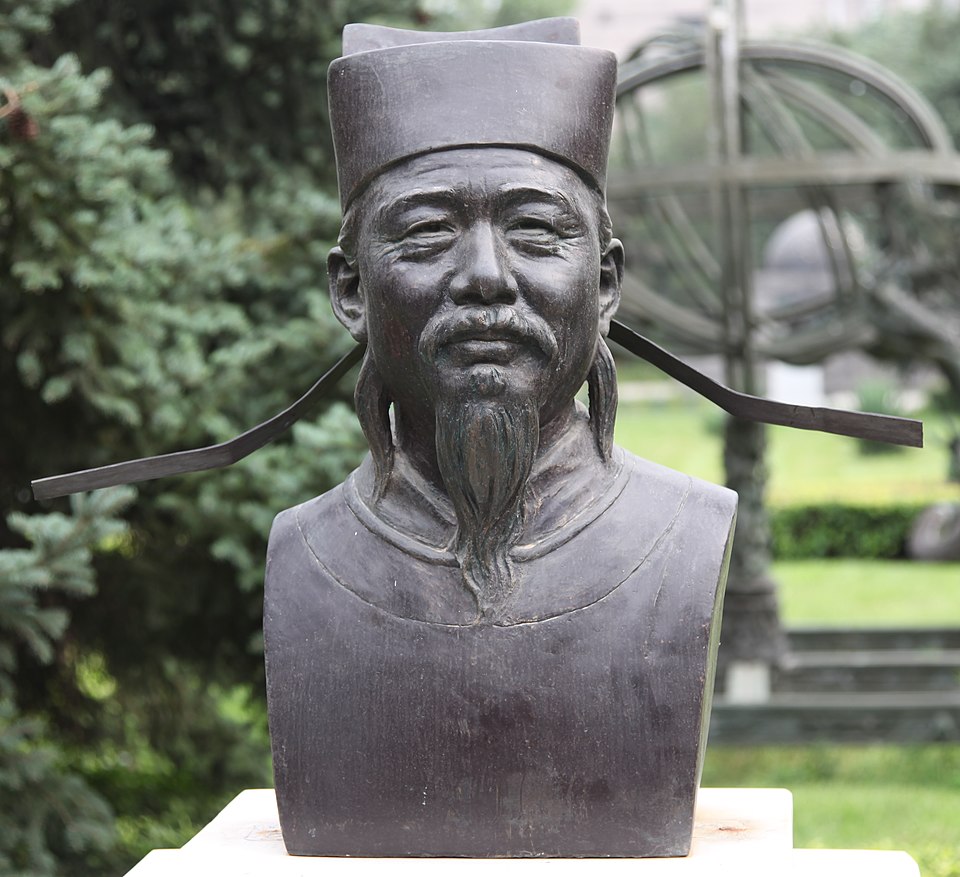
Shen Kuo (Chinese: 沈括; 1031–1095) was a Chinese polymath, scientist, and statesman of the Song dynasty (960–1279). Shen was a master in many fields of study including mathematics, optics, and horology. In his career as a civil servant, he became a finance minister, governmental state inspector, head official for the Bureau of Astronomy in the Song court, Assistant Minister of Imperial Hospitality, and also served as an academic chancellor. At court his political allegiance was to the Reformist faction known as the New Policies Group, headed by Chancellor Wang Anshi (1021–1085).
In his Dream Pool Essays or Dream Torrent Essays (夢溪筆談; Mengxi Bitan) of 1088, Shen was the first to describe the magnetic needle compass, which would be used for navigation (first described in Europe by Alexander Neckam in 1187).Shen discovered the concept of true north in terms of magnetic declination towards the north pole, with experimentation of suspended magnetic needles and "the improved meridian determined by Shen's [astronomical] measurement of the distance between the pole star and true north". This was the decisive step in human history to make compasses more useful for navigation, and may have been a concept unknown in Europe for another four hundred years (evidence of German sundials made circa 1450 show markings similar to Chinese geomancers' compasses in regard to declination).
. . .Shen Kuo wrote extensively on a wide range of different subjects. His written work included two geographical atlases, a treatise on music with mathematical harmonics, governmental administration, mathematical astronomy, astronomical instruments, martial defensive tactics and fortifications, painting, tea, medicine, and much poetry. His scientific writings have been praised by sinologists such as Joseph Needham and Nathan Sivin, and he has been compared by Sivin to polymaths such as his Song dynasty Chinese contemporary Su Song, as well as to Gottfried Leibniz and Mikhail Lomonosov.
An excerpt from, "11th-century polymath was the first to recognise past climate change" By Michael Le Page, New Scientist, October 8, 2022:
An 11th-century polymath called Shen Kuo was the first to recognise that the climate has changed in the past, science communicator Simon Clark told New Scientist Live in London on 8 October.
The history of the science of weather and climate is very Eurocentric, said Clark. So, while writing his book Firmament, published earlier this year, he looked at what was happening elsewhere and came across Shen’s work.
In a 1088 work called Dream Pool Essays, Shen wrote about how a landslide exposed a cavity in a riverbank in what is now Yan’an in Shaanxi province in northern China, where conditions aren’t suitable for bamboo to grow. But in the cavity, Shen found bamboo plants that “had turned to stone”.
Puzzled by this discovery, Shen suggested that, in ancient times, the climate in the region must have been different. This is arguably the first written account of how the climate in specific places could change over time, said Clark.
An excerpt from, "Review: Recent Publications on Shen Kuo’s Mengxi bitan (Brush Talks from Dream Brook)" By Nathan Sivin, East Asian Science, Technology, and Medicine, 2015:
Shen Kuo’s (1131-1195) polymathic collection of jottings is attracting more attention lately. A generation ago, the only complete translation into a modern language of was that by the Kyoto History of Science Seminar into Japanese (Umehara 1978-1981). A decade and a half later, two translations into modern Chinese with the same publisher followed it a year apart, and in the next year, a German translation of selections that included almost half of the book. Since 1997, we have had a complete scholarly translation into modern Chinese and a couple of less scholarly ones, a complete translation into English, a reprint of the best edition of the text supplemented by substantial new notes, a useful critical study of the text, a new full-length biography of Shen, and some reflective essays on him and his work.
I will evaluate nine of these tomes, and will then raise a question that seems to me worth asking: What is the point—if any—of completely translating the many books of miscellaneous jottings like Shen's?
Video Title: Shen Kuo - The Renaissance Mind of Ancient China. Source: Dr. K. Date Published: October 25, 2024.
